

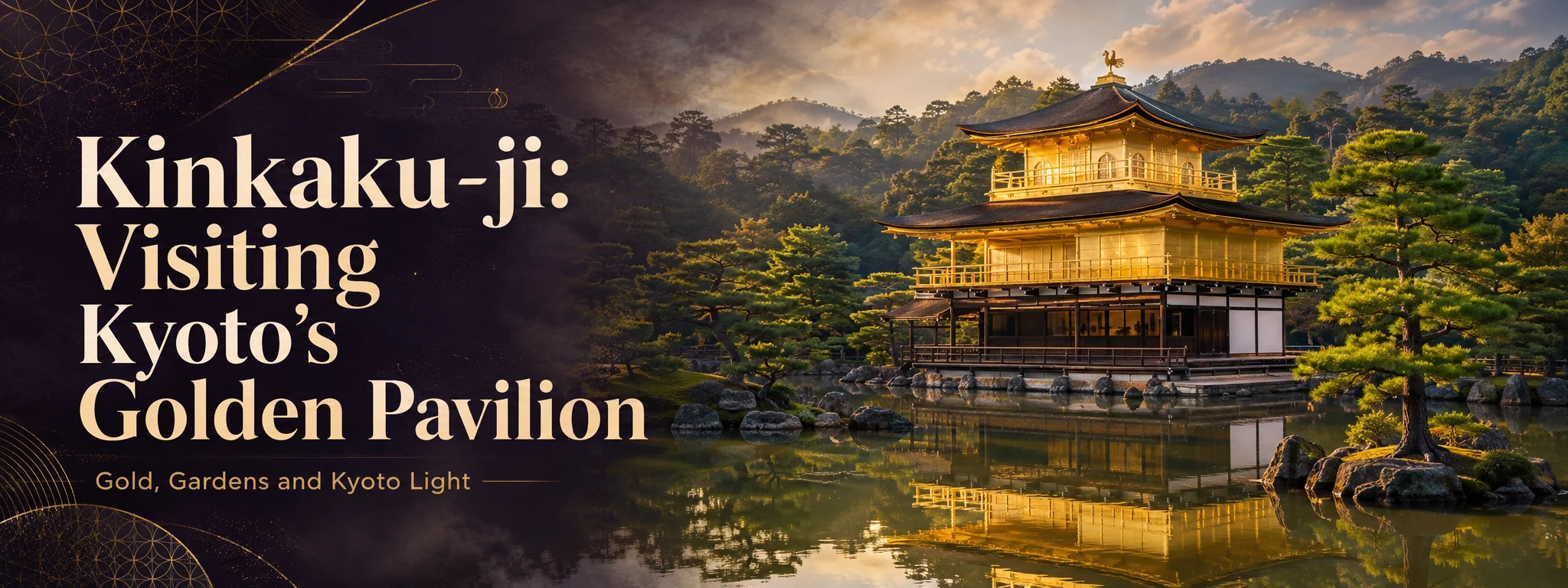
Kinkaku-ji is the Kyoto sight almost everyone recognises before they arrive: the Golden Pavilion reflected in Kyoko-chi pond, framed by pines and the wooded hills of northern Kyoto. The famous building is only one part of the visit, though. Kinkaku-ji is the popular name for Rokuon-ji, a Rinzai Zen temple whose grounds preserve the garden vision created around the late-14th-century villa of shogun Ashikaga Yoshimitsu.
What Kinkaku-ji actually is
The formal temple name is Rokuon-ji. Yoshimitsu acquired an earlier aristocratic estate here and developed it as Kitayamadono, his retirement villa. After his death in 1408, the site became a Zen temple in accordance with his wishes. The pavilion itself is known as Shariden, a reliquary hall; its upper two storeys are covered in gold leaf, which gives the complex its familiar nickname.
The pavilion seen today is a reconstruction completed after the original structure was destroyed by fire in 1950. That does not make the site a modern theme-set: the garden composition, relationship between architecture and pond, and temple setting are the point of the visit. Kinkaku-ji forms part of UNESCO's Historic Monuments of Ancient Kyoto World Heritage listing.
You do not go inside the Golden Pavilion
Plan for an outdoor garden visit, not a palace or museum tour. The pavilion is viewed from across the pond and again from points along the prescribed walking route. The interior is not normally open to visitors. This matters when comparing Kinkaku-ji with places such as Nijo Castle, where historic interiors are a major part of the experience.
The first pond-side viewpoint is the classic photograph. It can feel crowded because nearly everyone pauses in the same area. Once the route moves beyond that first view, the pressure usually spreads out and the experience becomes more about the garden itself.
How the one-way-style garden route works
After the main view across Kyoko-chi, the path follows the pond and climbs gradually through the grounds. Smaller features reward paying attention: islands and carefully placed stones in the pond, old pines, the Sekka-tei teahouse area, and viewpoints that reveal how the pavilion was composed as part of a larger landscape rather than as an isolated gold object.
Most visitors spend about 45–60 minutes on the grounds if they stop for photographs and take in the upper garden. A brisk visit can be shorter, but allowing an hour prevents the whole experience becoming a queue for one photograph followed by a rush to the exit.
Best time of day for a calmer visit
Kinkaku-ji opens at 9:00 a.m., so it cannot be treated like Fushimi Inari, where an extremely early start can put you ahead of normal sightseeing traffic. If this is a priority sight, arriving shortly before opening is still the most practical crowd strategy. Tour groups build through the morning, and the main pond viewpoint has limited room.
Late afternoon can also be more comfortable than the middle of the day, but do not cut it too fine: admission ends with the temple's closing schedule, and the light on the pavilion varies with cloud, season and angle. There is no reliable promise of the perfect reflection seen in promotional photographs.
Getting there from Kyoto Station
Kinkaku-ji sits in Kita Ward, well north-west of Kyoto Station and away from Kyoto's densest rail corridors. Kyoto City's official visitor guidance recommends combining rail or subway with a shorter bus ride rather than taking a bus all the way from Kyoto Station through city traffic.
A useful route is the Karasuma Subway Line from Kyoto Station to Kitaoji, then City Bus 204 or 205 to Kinkakuji-michi, followed by a short walk. Another option is JR to Enmachi and then a bus. Exact journey times depend on transfers and road congestion, so use a live route planner on the day.
Getting there from downtown Kyoto
From the Shijo/Kawaramachi area, do not assume a through-bus is automatically fastest. Kyoto's official guidance recommends reaching the Karasuma subway corridor and travelling north toward Kitaoji before transferring to a bus. The underlying principle works across Kyoto: use trains and subways for the long leg, and buses for the final gap to attractions without convenient stations.
Accessibility: the important limitation
The temple states that wheelchair users and visitors with strollers can reach the Golden Pavilion viewpoint, and accessible toilets are available. The full historic garden route is not barrier-free, however. Beyond the pavilion there are steps; wheelchair users, stroller users and people who cannot manage them need to turn back and return toward the entrance rather than complete the upper loop.
Wheelchairs may be borrowed if available without advance reservation. If mobility is a central concern, treat seeing the main pavilion as the accessible core experience rather than expecting the entire garden circuit to be step-free.
Luggage, food and practical restrictions
Kinkaku-ji says it has no luggage storage or lockers. Do not arrive with a large suitcase if you can avoid it. Kyoto City actively promotes hands-free sightseeing because large bags make already-busy public transport harder for visitors and residents alike; leave luggage at your accommodation, a station locker or a delivery/storage service before heading north.
The garden is not a picnic area, and the temple states there is no place to eat a boxed meal inside the garden. Keep the visit lightweight: water, a small day bag and weather protection are more useful than carrying a day's worth of gear.
Photography without blocking everyone else
The pond viewpoint is busy because it is genuinely the best broad view. Take your photograph, then move along rather than holding the rail for a long shoot. A phone or normal travel zoom is enough for most visitors; a tripod is more burden than benefit in a moving crowd. Cloudy weather can actually make the gold stand out, while rain deepens the surrounding greens.
If snow falls, Kinkaku-ji becomes exceptionally photogenic and exceptionally popular. The temple's own website provides a live camera, which is more useful than relying on old social posts to decide whether snow is currently settling on the grounds.
What to look for beyond the gold
Try to read the pavilion vertically. Its three levels deliberately draw on different architectural traditions, while the phoenix at the roofline and the gilded upper storeys turn it into an image of political and spiritual prestige. Then look outward: the pond, islands, pines and borrowed hillside scenery are what make the pavilion appear inevitable in its setting.
This is also why a quick selfie-and-leave visit feels strangely thin. Kinkaku-ji makes more sense as a landscape composition tied to Yoshimitsu's Kitayama culture than as a single famous building.
Pairing Kinkaku-ji with Ryoan-ji
Ryoan-ji is the most natural next stop. Its dry landscape rock garden offers a deliberately austere contrast to Kinkaku-ji's gilded spectacle, and the two are close enough to combine without crossing Kyoto. From there, Ninna-ji is another logical continuation if you want a northern-temple day.
Do not pair Kinkaku-ji with every eastern Kyoto highlight simply because they all fit on a checklist. Kiyomizu-dera, Gion and Fushimi are on the other side of the city; repeated cross-city transfers waste the time you were trying to save.
A sensible northern Kyoto half-day
For a first visit, start at Kinkaku-ji near opening, continue to Ryoan-ji, then decide whether to add Ninna-ji or return toward central Kyoto. This keeps the day geographically coherent and gives Kinkaku-ji enough breathing room without pretending it is a half-day attraction by itself.
- 09:00: Kinkaku-ji soon after opening.
- 10:00-ish: move toward Ryoan-ji.
- Late morning: continue to Ninna-ji or head back toward the centre for lunch.
Temple etiquette
Kinkaku-ji is one of Kyoto's busiest attractions, but it remains a Buddhist temple. Follow staff directions, stay on the visitor route, do not enter closed areas, keep drones away, and avoid treating worship spaces as photo props. Quiet courtesy matters most when crowds make the site feel like a tourist attraction first and a religious place second.
Is Kinkaku-ji worth it?
Yes for most first-time Kyoto visitors, provided you plan it for what it is: a famous, compact garden visit in northern Kyoto rather than an immersive interior attraction. The gold pavilion really is striking, but the better reason to go is to see one of Kyoto's clearest examples of architecture, water and landscape designed as a single image.
If crowds make you miserable and your itinerary is already packed, it is also reasonable to prioritise a quieter temple. Kyoto has no shortage of alternatives. Kinkaku-ji earns its place through visual impact and historical context, not because every visitor must tick the same box.
Check before you go
For current opening hours, admission, accessibility notices and the temple's live camera, use the official Kinkaku-ji website operated by the Shokoku-ji school. For the least congestion-prone route, use Kyoto City's official travel guidance or a live transit planner rather than relying on a fixed bus itinerary copied years ago.